Adaptation: A trait that make a living thing better able to survive.
Some animals can adapted to the color were they are.
Cell: The basic unit of all living things.

A characteristic of living things is to have cells.
Cell membrane: The cell part that gives the cell shape and holds the cytoplasm.
If cells doesn't have cell membrane then it will not have shape.
Cellular respiration: The process by which food is broken down and energy is released.
By cellular respiration we have energy.
Cell Wall: The thick, outer covering outsider the cell membrane.
The plants have cell wall, likeyou can see in the picture.
Centriole: cell parts that help with cell reproduction. Centrioles are important because it helps on he cell reproduction.
Chloroplast: cell parts that contain the green pigment, chlorophyll.
The chloroplast contain the chlorophyll, so plants have it.
Chromosome: cell parts with information that determines what traits a living thing will have.
If you look at the picture you will see that chromosome looks like a "X".
Consumer: Living things that eat, or consume, other living things.
Dogs are consumers, like lissy on the picture.
Cytoplasm: the clear, jellylike material between the cell membrane and the nucleus that makes up most of the cell.
All cells contain cytoplasm, so all living things have it.
Development: All the changes that occur as a living thing grows.
Yesterday we new that KPMG has a great development.
Diffusion: The movement of a substance from where there is a large amount of it to where there is a small amount of it.
On the mitochondria diffusion take place.
Mitochondria: Cell parts that produce energy from food that has een digested.
Without mithochondria we will not have energy.
-HUMANS
Nuclear membrane: A structure that surrounds the nucleus and separates it from the rest of the cell.
The nuclear membrane is on the surrounding of the nucleus.
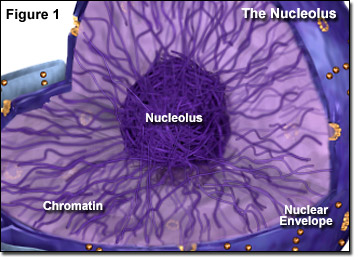
Nucleolus: The cell part that helps make ribosomes.

Thanks nucleolus for helpto make ribosomes.
Nucleus: The cell part that controls most of the cell’s activities.
The nucleus is very important because it controls most of the cell's activities.
Organ: Group of tissues that work together to do a job.
Somes organs are the panchreas, the kidnes, the lungs, the brain, etc...
Organism: A living thing.
The babies are organisms like plants or protist but are some characteristics that make the difference.
Organ system: A group of organs that work together to do a certain job
An example of organ system can be the skeleton system.
Osmosis: The movement of water across the cell membrane.
Is the diffusion on water.
Producer: Living thing that make, or produce, its own food.
The carrot plants are examples of producers.
Reproduce: To form offspring similar to parents.
Every mammal have an offspring like every living thing.
Ribosomes: Cell part where proteins are made.
The proteins are make on rivosomes.
Tissue: Group of similar cells that work together to carry out a special job.
The organs are made of tissues and the tissue of cells.
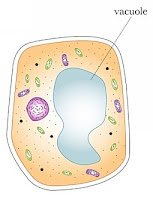
Vacuole: A liquid-filled space that stores food, water and minerals.
The vacuole contains minirals, food and water.